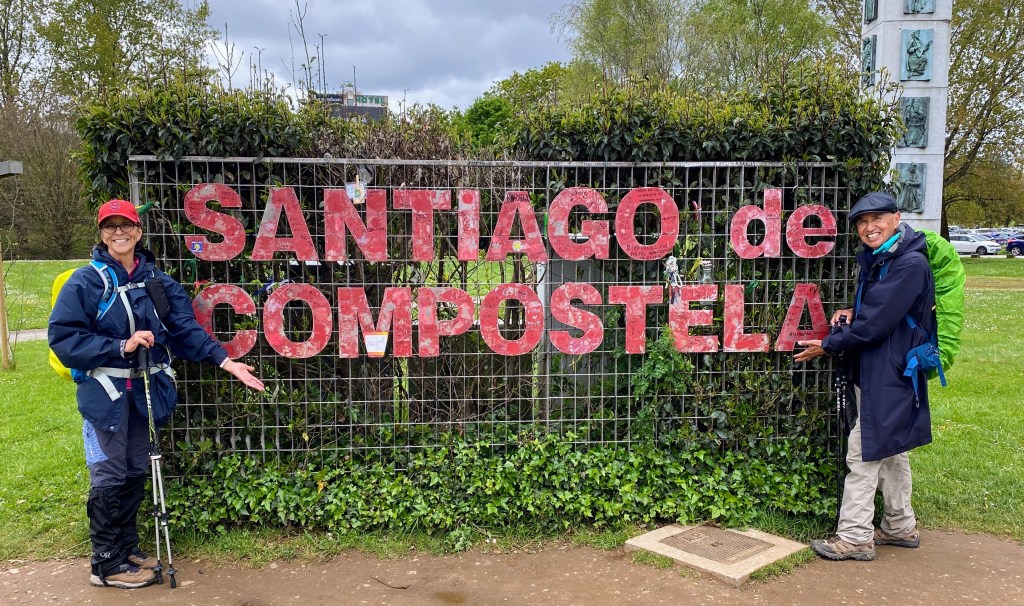
I cannot say we enter the main plaza in Santiago de Compostela, Praza do Obradoiro, with the triumphant glee you see in Instagram pictures. We don‘t dance around in the bright sun-filled Praza. We don’t kiss the earth or hug the statue of Saint James. We don’t even hug each other. There is no rapture. Not today, anyway. Yet, we make it together. We have encouraged each other and taken care of each other (and others, I hope) on the Camino. We enter the city of Santiago relieved, happy with the constant guidance of yellow arrows and shells. At the entry into the first real city on our Camino, we ham it up at the sign that announces the city. Ahead of us are still around 3.5 miles of uphill, confusing streets and alleys, and the worst rainstorm of our Camino replete with hail. When we finally enter the Praza, our goal, we are at the end of our pilgrimage. Still, I have to process the accomplishment, to think about its meaning and its function in my life. Today was a challenging 14.5 miles and the last few were hard-won. Maybe that’s how life is.
Let me put the last day in perspective. We start the morning with cold rain in O Pino (also known as O Pedrouzo and Arca). Like all pereginos we eat a hearty but simple breakfast. I stow the uneaten croissants and fruit in my gear for later because I’m burning over 3000 calories a day, according to Fitbit. I can’t get enough food. Our destination is “near” and we start walking on our final stage under a silver mist that turns to a dull pewter gray rain. Keeping my snacks company in Sofia, my newly named backpack, are gaiters, extra socks, rain poncho, cell phone, printed directions to our hotel in SdC, and an extra down jacket. We easily find our yellow arrows skirting the town. Our first chat of the morning is with an español who already has his rain poncho on in the thick rain. As he passes us, he says, “¡Que desmadre!” in reference to the soaking now coming down slowly and heavily from Payne’s Grey clouds. We catch up to him later, but for now, he trudges past us on the steep elevation rise. Luis’s rain jacket is doing its job, but I need to change out of my windbreaker and don my rain poncho over my goose down. Everyone along the Camino trail has a hodgepodge of brightly colored raingear from all over the world. This is quite a different European fashion runway. Meanwhile, I try to focus on the soft edges of the trees and distant hills, the proximity of our goal, and the beauty of the rain. There is farming out here, alternating with patches of trees and some forests, too. But there is so much rain and this is sloppy walking. Focus, Rosana, focus! You wanted this. You worked and trained for this. The natural beauty is overwhelming. But it’s hard to see through my rain-dappled glasses. Focus, already. It might all be an allegory for attaining a challenging goal. Then I step into another mud puddle and lose my focus. Sigh.
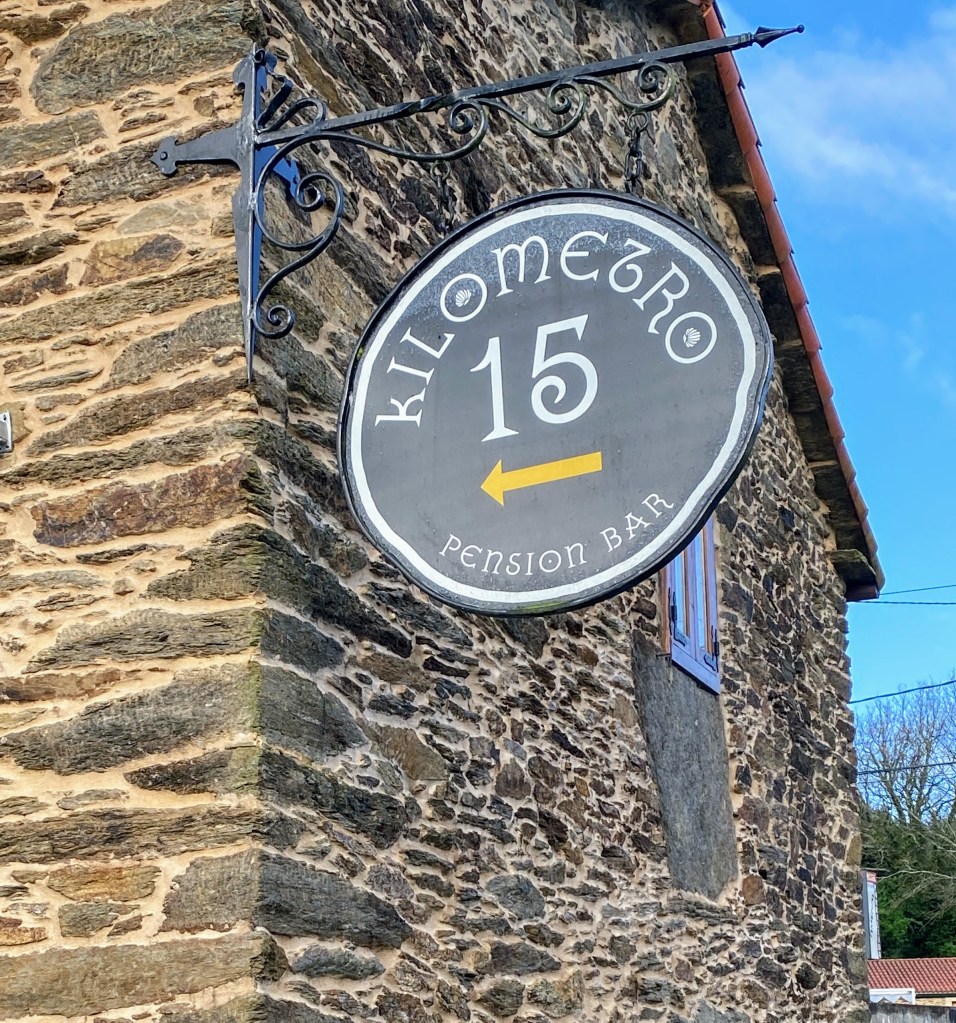
We continue and before you know it we’ve tackled 8 km (5 miles) and we have only 15 km (9 miles) more to go, assuming we don’t get lost. The sky looks cerulean and we stop at a cafe bar, Kilometro 15, popular with a mountain of walkers. We get the coveted stamps in our credentiales, I stretch my hips, my thighs, and my lower back, and Luis uses the bathroom. And we are off again. I shake off random drops of water on my poncho and we start another ascent.
With the sun warming me, I can get back to focusing. I’m under the misconception that this is the way it will stay for the remainder of the day. We climb up gentle hills. I’m still garbed in my fancy, 6-Euro yellow poncho. Another name for it is a mobile sauna. As much as I don’t want to stop, I have to before I pass out from the heat I’m building by walking inside of the plastic and down. We find a patch of shade and, like most others on the trail, I begin the process of disrobing from the poncho, unzipping the jacket, stripping off the gloves.
On we go, metaphorically skipping along in the sun and shade cast by trees. In reality, we are putting one foot in front of the other. Much like our daily lives at home, we go forward and from time to time, turn around and see the beautiful path and surroundings we traversed. This reminds me of the adage about not seeing the forest for the trees. Right now I promise myself to remember this view, to hold on to the beauty of the Galician countryside on full display, to imprint it in my memory.
The rain returns. We stop so I can extract the poncho from its pouch, fight with it to put it on, and put on the backpack. Nope. I have to strap on the backpack first, readjust the straps, snap the hip belt, then the chest strap, make minor adjustments on the lengthening straps, THEN fit the poncho over it all. I look like a kindergartner trying to get dressed in her mommy’s evening gown. Everything is too big, I put it on inside out and have trouble putting my head through the neck. And now there’s a breeze. Luis indulges me with this costume addition. All is set when the clouds break apart to reveal a blue sky. I am starting to agree with our fellow traveler, ¡Que desmadre!
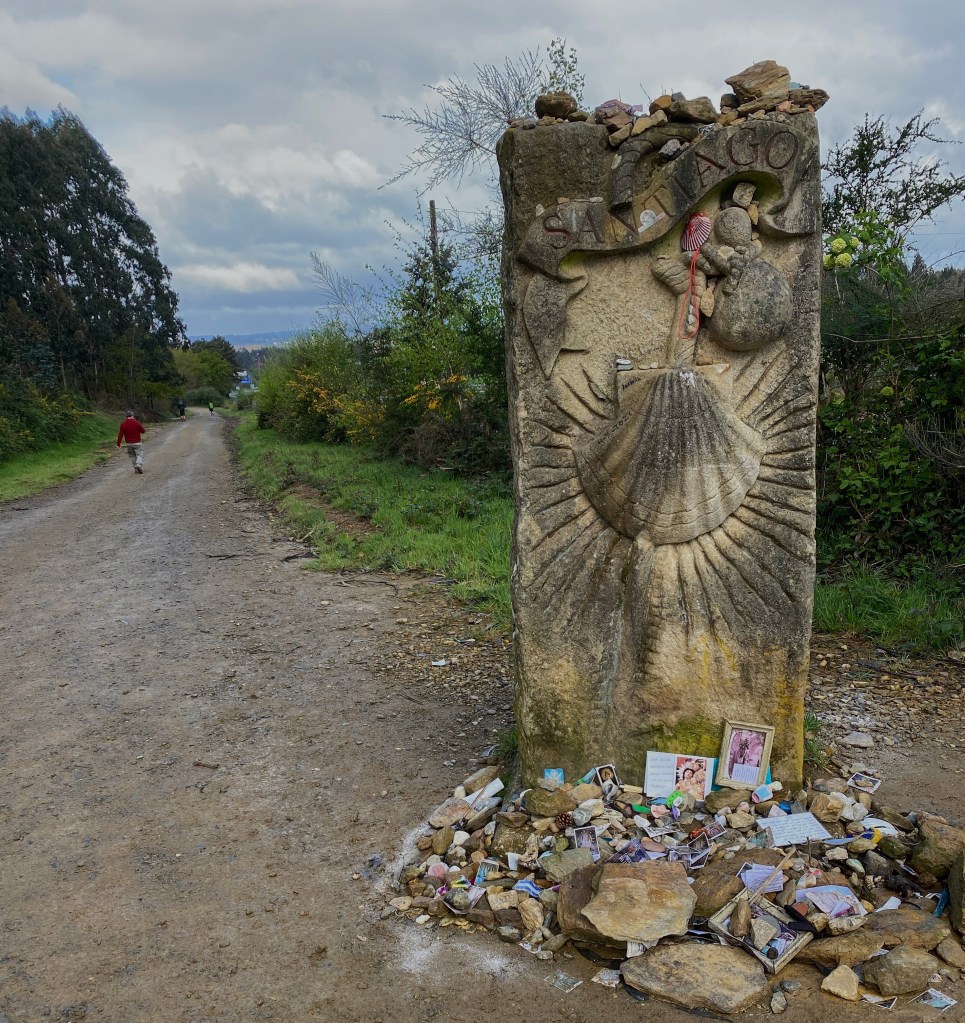
Two moments of connection catch us off-guard. We stride alongside our Spanish friend from earlier. I dubbed him “Señor Que Desmadre” but his name is Javier. He is from Madrid and committed to the Camino with a couple of friends. Delicately he wants to know how old we are. He wants to encourage his mom to go on Camino though she says she’s too old. Hmmm. Both Luis and I are older than his mom. In reflection, I realize there are few older than us on the Camino today. Maybe none. With Sr. Que Desmadre, we discuss life goals and what is important, the history of language imposition as a means of subjugation. And then, just like that, he is out of our lives. We round the bend and realize we have ascended our high highest elevation of the day as we go along the perimeter of the Santiago airport. Here is our second unexpected connection, this time more intimate. Our path wraps around the end of the airport and to a stone monument where people have left prayer cards, stones, and handwritten messages. We pass it. I backtrack realizing this is The Place. This is the place to spread Lenny’s ashes. He would like it here on a high hill, outside on the Camino. I suddenly realize the rainwater on my face is in fact tears. I miss Lenny and can only imagine the grief Tina endures for him. Seven years ago, the two of them made the Camino together while Luis’s cancer reemerged. Lenny and Tina arrived home from Santiago and came straight to visit us and encourage us to make the Camino. We had no idea that Lenny would be diagnosed with cancer and succumb to it. I pray that he knows we are following his advice.
The heavens continue to test us today. We are happy to spot a sign that other pilgrims are snapping photos of. It announces that in the next community there are not one, but two cafe bars! Glory be! It’s a town with sanctuaries from the elements. The deluge has begun again driving all travelers into these sheltering beacons and into the small stone chapel.
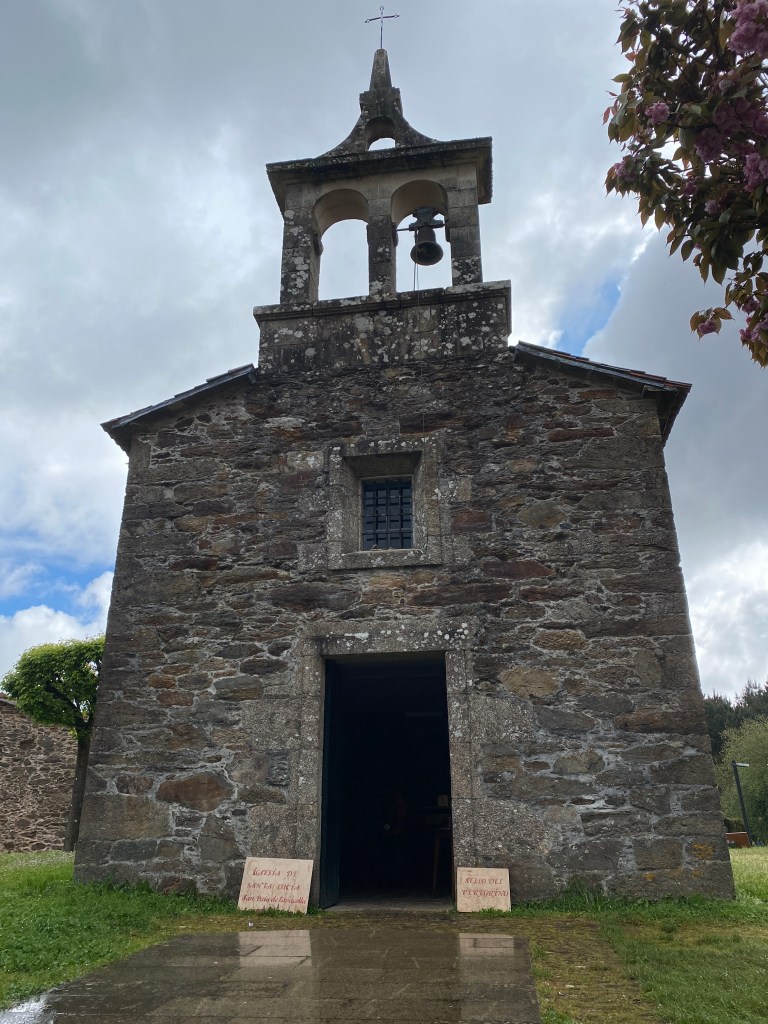
A Camino volunteer sits at the entrance to the stone chapel. She provides assistance to weary and wet pilgrims and a stamp. In her florescent orange vest and in her Italian-accented Spanish, this middle-aged, well-groomed woman welcomes us and gives us a stamp on our credentiales. She tells us she lives near Milan and comes every year to volunteer along the Camino. She invites us into the stark stone chapel from the 1400s. She, too, finds refuge from the rain. It has stood over the centuries through many rainstorms and has provided a shelter for countless pilgrims flowing like a gathering river to Santiago. After a silent prayer, we thank the Italian and cross the little lane and find one of two cafe bars, order espressos, and eat the bananas and croissants as a second breakfast. Hobbit-style, I’m already wondering about the next meal. We make fast friends with fellow travelers, including a man about Luis’s age (mid-70s) who’s a retired teacher from the Netherlands. We will see him later at the Pilgrims’ Office and in the Praza Obradoiro in Santiago, ah, but I get ahead of myself. Two women from Mexico, one of them a teacher, strike up a conversation with us. They tell us they just knew we were Mexicans because of our accents. We enjoy a regular old educators’ conference in this cafe bar with four tables and no less than 20 dripping pilgrims. We can’t stay, though, so I slap on my gaiters and we stride out refreshed and happy we’ve visited with such pleasant people.
The rain slackens off and we enter Lavacolla which has another serene church, Igrexa de San Paio de Sabugueira, and a huddle of homes. We nod to a lady coming out of her home and she wishes us another “Buen Camino.” I’m getting hungry but there isn’t any place to eat and we MUST be approaching Santiago. We dip into the valley and pull out of it again, passing a most impressive scene of large, communal washing basins along the bank of the river. The walls of the laundry pools are made of gigantic slabs of granite. We cross a bridge and then up another hill. Our Norwegian friend easily passes us with his long strides while we are pulled out to remove a layer of clothes.

We are seeing more industrial sites, a television station complex, and the beginnings of suburbs. We pass a campsite and a fence where people have placed crosses made of sticks, creating a gallery of crosses. I don’t know what it’s about. I only know that it’s likely “curated” by pilgrims.
We visit with three college students from Valencia on our final approach to Santiago. One of the three tells us about his ambitions for a start-up company that delivers made-to-order cocktails and how he will be in San Francisco for an MBA in the fall. His traveling partner tells me about how her grandparents are the only generation in her family who can still speak Valencia after the Franco years outlawed it. And, boom, we are at the sign that we’ve entered Santiago.
I think we have arrived. Little do I know that it would be another 3.5 miles of winding streets to go. And the most interesting disappearance act of all is occurring. For about 70 miles we have been guided by a clearly marked route across the countryside. Now the arrows have dissolved. There isn’t a shell to be found. Maybe the rain is playing tricks on us. It’s like the great Nile River that disappears into the delta, like Amelia Earhart’s journey across the Atlantic. The temperature drops and so does the precipitation. We manage to keep going and then “the Camino provides.” Wet and worn out, we ask an older couple with their adult son, all on vacation from another part of Galicia, where the Cathedral is and they point the way just as the skies unleash a torrent of rain. The family insists we gather under their umbrellas. The walk us part the way to the Cathedral and the Praza. One more challenge greets the 5 of us: it is hailing little ingots which turn into larger and larger stones. We all plaster our backs against ancient buildings hoping to be spared. Water gushes downhill making the cobblestones slippery. The family gets us close to the Cathedral. We follow the sound of bagpipes and stumble through the arch on the Praza! I realize this is no Kodak moment. Our accomplishment is to be contemplated later. We need to find our hotel and food. Especially, food. We try to follow our printed directions to the Hotel Costa Vela, but get lost. Asking for directions from some local men, we don’t understand their references to landmarks and we go the wrong way. We zigzag through these medieval streets without the benefit of street signs. We ask another local gentleman, and he sends us off in another direction. Again, it takes us further afield. The Camino doesn’t want us to stop walking. But my stomach does. We eventually find our hotel and we can shed our hiking clothes for fresh ones. We head down to the glass-enclosed terrace bar. They don’t serve food, they say, and yet, suddenly they’ve brought me the best-tasting jamon serrano, olives, and homemade potato chips to go with our wine. There is much to consider and analyze, but for now, I’m savoring the moment, the wine, the jamon, the warmth of the cafe bar, and my husband at my side.


 Ordinary Gente
You should be proud of yourself. And Luis should be proud of himself. Reading this, I feel like I was with you on your journey.